

Key Sustainability Pillars of e‑SAF
The Key to e-SAF Sustainability




The Key to e-SAF Sustainability
The feedstock for e-SAF is straightforward: it does not rely on biomass, waste oils or crude oil. Instead, e-SAF can be synthesised solely from renewable electricity, water and carbon dioxide.
This power-to-jet pathway has moved beyond conceptual design and into real-world deployment. That said, two fundamental challenges must be overcome to deliver export-grade commercial fuel compliant with international standards: where the carbon comes from, and where the electricity comes from. The compliance status of both the carbon source and power supply jointly determines the fuel’s lifecycle emissions performance, and is critical to securing international certifications and accessing aviation markets.
CO₂ sources used in current e-SAF R&D and demonstration projects fall into three main categories: CO₂ captured via direct air capture (DAC), CO₂ captured from industrial point sources, and biogenic CO₂. Differences in the compliance attributes of these sources directly govern whether the product meets export standards and long-term commercialisation requirements.
e-SAF projects require upfront green compliance verification for CO₂ sources, covering credentials, certification compatibility and lifecycle carbon emissions. A common misconception is that the main hurdle is obtaining CO₂ itself. The real challenge lies in securing a compliant carbon supply that is long-term, stable, scalable, traceable and recognised by international certification frameworks.
The dominant certification schemes for e-SAF today are ISCC EU RFNBO and CORSIA (the Carbon Offsetting and Reduction Scheme for International Aviation). Under EU Commission Delegated Regulation (EU) 2023/1185 and ISCC rules, five categories of CO₂ qualify as compliant: DAC-captured CO₂, industrial CO₂ covered by an effective carbon pricing system, biogenic CO₂, CO₂ recovered from combustion of compliant RFNBO/RFC, and geogenic CO₂.
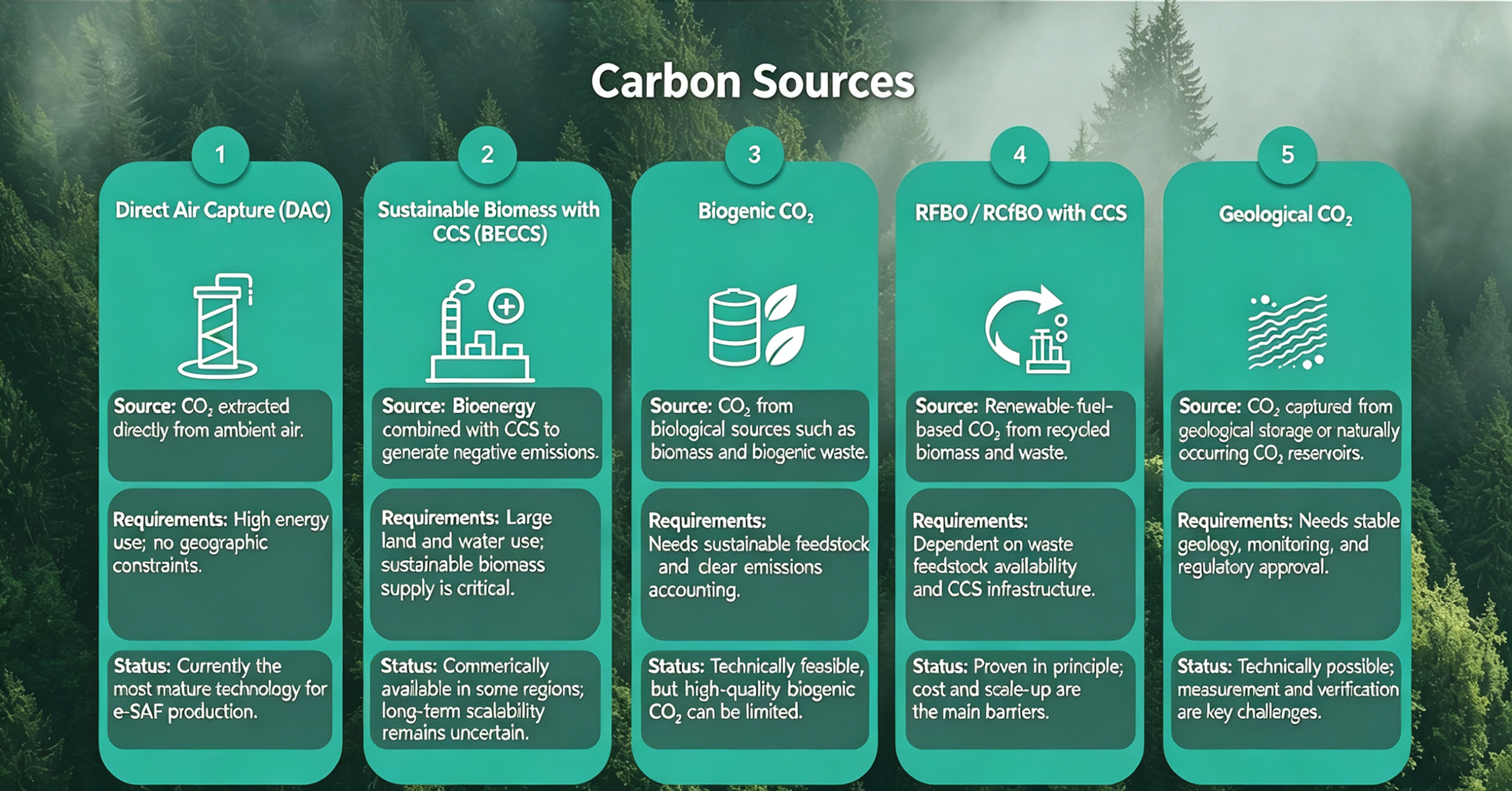
DAC-sourced CO₂ carries distinct advantages: a clear certification pathway with strong policy certainty and no sunset clause. Projects enjoy flexible siting, unconstrained by the geography of emission point sources or carbon pricing regimes. Carbon supply can be sustained at scale without bottlenecks, making DAC well suited for long-term commercial rollout.
Even with a DAC carbon source selected, the compliance loop is not closed. The low-carbon credential of e-SAF hinges heavily on renewable electricity, which represents a separate non-negotiable eligibility criterion.
The renewable electricity used to produce e-SAF defines the fuel’s value and industrial scalability, and is the core feature that distinguishes it from conventional bio-SAF.
Under ISCC EU rules, compliant renewable electricity must satisfy one of the following criteria:
a) Direct wired renewable power supply;
b) Grid electricity with a very high renewable share (≥90%);
c) Grid electricity with low emission intensity (below 18 gCO₂eq/MJ);
d) Electricity from curtailed wind and solar;
e) Grid-sourced power must additionally meet requirements on additionality, temporal-spatial matching and power purchase agreements (PPAs).
China’s grid currently does not meet the high renewable penetration or low emission intensity thresholds. Demonstrating use of curtailed wind and solar power requires transmission system operators to verify curtailment events, with consumed electricity offset against curtailed volumes—this creates heavy traceability and evidentiary burdens. Furthermore, EU certification bodies maintain uncertainty over the recognition of Chinese renewable energy certificates, curtailment proof and PPAs.
Against the characteristics of China’s grid and the certification rules for renewable power, on-site generation such as solar PV paired with direct wired renewable supply is the preferred practical route for domestic projects targeting ISCC EU certification. Carbonology has implemented this model and secured filing for Ningxia’s first off-grid direct renewable power connection project.
Carbonology draws CO₂ from ambient air, decoupling operations from industrial emission stacks and biomass feedstock. This delivers high flexibility in carbon sourcing and project siting, alongside clear compliance status with no sunset provisions. Meanwhile, the direct wired renewable setup enables certification and verification of power origin via physical interconnection and metering, mitigating risks around grid emission intensity, cross-border recognition of renewable certificates and curtailment documentation. Together, this combination satisfies RFNBO carbon classification rules, the 70% emissions reduction threshold and end-to-end traceability requirements. It materially de-risks certification, expands viable siting options and represents the ultimate long-term pathway for e-SAF.
